
Details
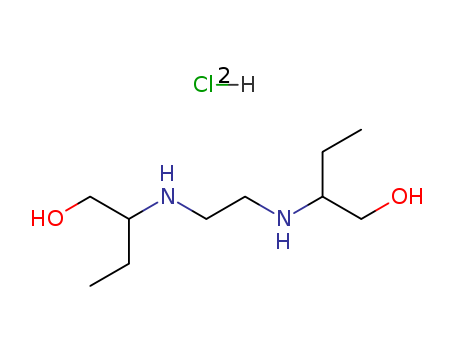
Manufacturer Supply Best Quality Ethambutol dihydrochloride 1070-11-7 with Efficient Transportation
- Molecular Formula: C10H24N2O2*2ClH
- Molecular Weight: 277.235
- Appearance/Colour: white powder
- Vapor Pressure: 3.35E-07mmHg at 25°C
- Melting Point: 198-200 °C
- Boiling Point: 345.3 °C at 760 mmHg
- Flash Point: 113.7 °C
- PSA: 64.52000
- LogP: 2.09320
Ethambutol dihydrochloride(Cas 1070-11-7) Usage
|
Manufacturing Process |
To 27 grams (2.55 mols) of 2-amino-1-butanol was added 100 grams (1.0 mol) of ethylene dichloride. The mixture was heated at reflux and in a few minutes, the exothermic reaction required the removal of exterior heating. After 10 minutes, exterior heating was recommenced for an additional 20 minutes. The hot mixture was then treated with 300 ml of methanol and then cautiously with 84 grams (2.1 mols) of sodium hydroxide in 80 ml of water.The precipitated sodium chloride was removed by filtration. The excess 2- amino-1-butanol distilled as light yellow oil at 83° to 87°C/13 mm. The viscous residue distilled at 165° to 170°C/0.6 mm as a light yellow oil which tended to solidify in the air condenser; yield, 108 grams.Recrystallization by dissolving in 80 ml of hot ethanol, adding about 150 ml of petroleum ether (BP 90° to 100°C) and cooling at 5°C overnight, gave 64 grams of white crystals melting at 128° to 132.5°C. This, on recrystallization from 100 ml of 95% ethanol, gave 35 grams of white crystals melting at 134.5° to 136°C and a second crop of 10 grams melting at 132.5° to 134°C which is the meso base. Its dihydrochloride melts at 202° to 203°C.From the ethanolic filtrates upon addition of 130 ml of about 4 N ethanolic hydrochloric acid and cooling, there was obtained 55 grams of white crystals melting at 176.5° to 178°C and a second crop of 10 grams melting at 171.5° to 174.5°C. This is the dl racemate dihydrochloride. |
|
Therapeutic Function |
Antitubercular |
|
Biochem/physiol Actions |
Ethambutol is bacteriostatic against actively growing TB bacilli. Mycolic acids attach to the 5′-hydroxyl groups of D-arabinose residues of arabinogalactan and form mycolyl-arabinogalactan-peptidoglycan complex in the cell wall. Ethambutol disrupts arabinogalactan synthesis by inhibiting arabinosyltransferases, specifically those in Mycobacterium, interfering with the biosynthesis of arabinogalactans found in the cell wall of mycobacteria and leading to increased cell wall permeability. |
|
Drug interactions |
Potentially hazardous interactions with other drugs None known |
|
Metabolism |
Ethambutol is partially metabolised in the liver to the aldehyde and dicarboxylic acid derivatives, which are inactive.Up to 80% of a dose appears in the urine within 24 hours, 50% as unchanged drug and 8-15% as the inactive metabolites. About 20% of the dose is excreted unchanged in the faeces. |
|
Definition |
ChEBI: The dihydrchloride salt of ethambutol. A bacteriostatic antimycobacterial drug, it is effective against Mycobacterium tuberculosis and some other mycobacteria. It is used in combination with other antituberculous drugs in the treatment of pulm nary and extrapulmonary tuberculosis; resistant strains of M. tuberculosis are readily produced if ethambutol dihydrochloride is used alone. |
|
Brand name |
Myambutol (Stat Trade). |
|
General Description |
Pharmaceutical secondary standards for application in quality control provide pharma laboratories and manufacturers with a convenient and cost-effective alternative to the preparation of in-house working standards |
InChI:InChI=1/C10H24N2O2.ClH/c1-3-9(7-13)11-5-6-12-10(4-2)8-14;/h9-14H,3-8H2,1-2H3;1H/t9-,10-;/m0./s1
1070-11-7 Downstream products
-
3577-94-4
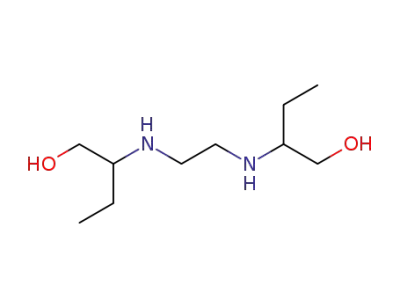
ethambutol
Related Products
-
 3-CARENE
CAS:13466-78-9
-
 Erinacine C Erinacin C
CAS:156101-09-6
-
 Niraparib
CAS:1038915-60-4